Laser Skin Resurfacing: What to Expect from Treatment to Recovery
Laser skin resurfacing is not a single treatment. Ablative lasers like CO2 and Erbium remove damaged surface skin for dramatic results and real downtime, while non-ablative lasers heat deeper layers with little to no visible recovery. The right choice depends on the specific concern, skin type, and how much downtime a patient can accept. At The One Plastic Surgery Center in Newport Beach, treatments are planned under the oversight of board-certified plastic surgeon Dr. Siamak Agha.
Laser Skin Resurfacing Is Not One Treatment
Most people searching for laser skin resurfacing in Newport Beach assume they are choosing between “getting the laser” or not. That way of thinking is too narrow. Ablative and non-ablative lasers are fundamentally different technologies, and the difference between a weekend of redness and two weeks of visible healing depends entirely on which category a provider recommends.
Ablative lasers, primarily CO2 and Erbium devices, work by vaporizing the outer layers of skin outright. Non-ablative lasers leave the surface intact and instead heat the tissue underneath to stimulate collagen, which is why the American Society of Plastic Surgeons notes that ablative and non-ablative approaches differ sharply in intensity, cost, and how long results tend to last. Understanding that distinction before booking a treatment changes what a patient should expect from day one through the final result.
Why Ablative and Non-Ablative Lasers Produce Such Different Results
The difference is not a matter of degree. It is a difference in mechanism. Ablative resurfacing physically removes the damaged outer layer of skin, cell by cell, which is why it produces the most visible improvement in a single session and why it also requires the skin to fully re-epithelialize before it looks normal again.
Non-ablative lasers take a gentler route. They pass energy through the skin’s surface without injuring it, targeting deeper structures to encourage new collagen over time. According to the Aesthetic Society, this is why non-ablative treatments are often described as a series rather than a one-time event, since each session builds gradually on the last rather than resurfacing the skin outright. Neither approach is universally “better.” They are built for different problems and different patients, and even within each category, intensity settings can be dialed up or down depending on how aggressive a patient wants the treatment plan to be.
Cost tends to follow that same logic. The American Society of Plastic Surgeons reports that non-ablative sessions average roughly a third of the cost of a single ablative treatment, though ablative patients are often paying for one comprehensive session rather than the repeat visits a non-ablative plan requires.
Matching the Laser to the Skin Concern
Deep static wrinkles, significant sun damage, and pronounced acne scarring generally respond best to ablative treatment because the concern lives in the skin’s structure and needs to be physically addressed rather than gradually stimulated. CO2 lasers are typically reserved for these more advanced cases, including deeper scarring and more resistant wrinkling, while Erbium lasers are often chosen for finer lines and more superficial texture concerns, since the Aesthetic Society notes Erbium energy is gentler on surrounding tissue.
Non-ablative and fractional devices tend to suit patients dealing with early sun damage, mild texture irregularity, enlarged pores, or subtle tone unevenness, particularly those who want visible improvement without stepping away from work or family obligations for a week or more. Skin type matters here as much as the concern itself. Patients with darker skin tones carry a higher risk of post-inflammatory hyperpigmentation after aggressive ablative treatment, which is one reason the American Academy of Dermatology’s own research emphasizes that Fitzpatrick skin typing should guide laser selection rather than treating every patient the same way. A consultation at The One Plastic Surgery Center is where this matching actually happens, since photographs and generic descriptions online cannot substitute for an in-person skin assessment.
What Determines a Good Candidate
Candidacy for laser resurfacing depends less on age and more on skin condition, medical history, and realistic expectations about downtime. Good general health, non-smoking status, and the ability to strictly avoid sun exposure during healing all determine whether ablative treatment is appropriate, while non-ablative options allow a wider range of patients to pursue gradual improvement with less commitment.
Certain factors do rule patients out or push them toward a gentler laser, and because this list resists being folded naturally into a single sentence, it is worth stating plainly:
- Active acne breakouts, cold sores, or skin infections in the treatment area
- Recent use of isotretinoin (typically within six to twelve months)
- A history of keloid scarring or poor wound healing
- Uncontrolled autoimmune or connective tissue conditions
- Unrealistic expectations about downtime or how much a single session can change
These are exactly the kinds of details that come out during a proper evaluation with a qualified provider, not from a menu of services online. As board-certified plastic surgeon Dr. Siamak Agha often reminds patients considering laser skin resurfacing in Newport Beach, the device matters less than the judgment behind it. Two patients with sun damage can walk in with nearly identical skin and walk out with different treatment plans because their tolerance for downtime, their skin type, and their long-term goals are not the same. That reasoning grounds every laser recommendation made under his oversight at the practice’s med spa, whether the plan calls for a single ablative session or a series of gentler non-ablative treatments spaced over several months.
What Treatment Day Actually Feels Like
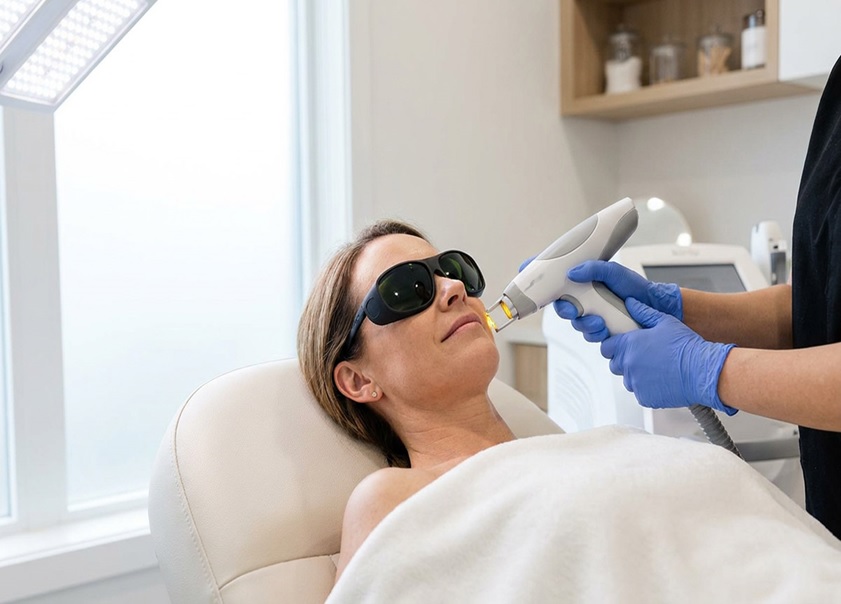
On the day of treatment, the skin is cleansed and a topical numbing cream is applied, with deeper ablative procedures sometimes calling for additional local anesthesia or oral sedation depending on the area being treated. The laser itself is passed over the target area in controlled passes, and most patients describe the sensation as warm snapping or a rubber-band-like feeling that intensifies briefly with each pass.
Non-ablative sessions typically wrap up in fifteen to thirty minutes with minimal preparation, while a full-face ablative treatment can take closer to an hour once numbing and aftercare instructions are factored in. Immediately afterward, ablative skin looks pink to red and feels tight, almost like a sunburn, while non-ablative skin usually shows mild redness that settles within hours to a day.
Before leaving the office, patients are typically sent home with clear aftercare instructions covering gentle cleansing, a bland moisturizer or occlusive ointment for deeper treatments, and strict sun avoidance. Ablative patients are often asked to arrange a ride home and to keep the first few days relatively low-key, since the treated skin is actively shedding and needs time before makeup or normal skincare products can go back on.
Recovery: Ablative vs Non-Ablative Timelines
This phase is where the two categories diverge most and where patients are most often surprised. According to the American Society of Plastic Surgeons, CO2 laser recovery generally runs up to two weeks, with crusting and peeling occurring within the first three to eight days, while Erbium laser healing tends to wrap up in about a week since the energy penetrates less deeply. Fractional versions of these ablative lasers shorten that window further, often allowing a return to normal activity within five to ten days depending on treatment intensity.
The laser a patient needs depends on the problem being solved, not on how dramatic the recovery sounds.
Non-ablative recovery looks almost nothing like ablative recovery. Most patients see redness and mild swelling for a few hours to a couple of days, wear makeup again within twenty-four to forty-eight hours, and repeat the treatment every few weeks over a series of sessions to build results gradually. Sun protection is non-negotiable regardless of which laser is used, since new skin is significantly more vulnerable to pigmentation changes for weeks or months after treatment.
Long-Term Results and Maintenance
Ablative resurfacing tends to deliver more dramatic, longer-lasting improvement from a single treatment, with results commonly holding for five to ten years when skin is properly protected afterward, according to the American Society of Plastic Surgeons. Non-ablative results are more modest per session and generally last one to five years with consistent skincare, which is precisely why they are often built into an ongoing maintenance plan rather than treated as a onetime event.
Neither timeline is a guarantee, since sun exposure, skin type, genetics, and how closely a patient follows aftercare instructions all influence how long results actually hold. What both approaches share is a dependence on the months following treatment, not just the day of the procedure itself, to reach their final effect.
Daily sunscreen, a consistent skincare routine, and periodic touch-up sessions for non-ablative patients all play a role in stretching results as far as possible. Patients who pair laser resurfacing with disciplined sun protection tend to hold onto their improvement noticeably longer than those who treat the procedure as a one-time fix and go back to old habits.
Choosing the Right Path Forward
None of these statements is meant to suggest one laser is superior to another. The entire premise of matching treatment to concern only works when a provider takes the time to understand a patient’s skin, goals, and lifestyle before recommending a device. That is the same principle behind every med spa treatment offered at The One Plastic Surgery Center, where the goal is a plan built around the patient rather than a single default option.
Results and candidacy vary from patient to patient, and a consultation is required before any treatment plan, ablative or non-ablative, can be recommended.
Ready to find out if laser skin resurfacing is right for you? Schedule a consultation with board-certified plastic surgeon Dr. Siamak Agha at The One Plastic Surgery Center in Newport Beach to discuss your goals and options.
Frequently Asked Questions
Is all laser skin resurfacing the same treatment? No. Laser skin resurfacing covers a range of technologies, primarily ablative lasers like CO2 and Erbium and non-ablative or fractional lasers. They differ significantly in intensity, downtime, and how many sessions are needed to see results, so the specific laser matters as much as the general procedure name.
Which laser is best for sun damage? It depends on how deep the damage runs. Mild sun damage and early texture changes often respond well to non-ablative treatment with little downtime, while more significant sun damage and deeper wrinkling typically call for ablative CO2 or Erbium resurfacing for a more noticeable single-session result.
How much downtime should I expect? Non-ablative treatments generally involve a few hours to a couple of days of mild redness. Ablative treatments involve a more significant recovery, with Erbium healing in about a week and CO2 typically taking up to two weeks for full skin re-epithelialization.
Can laser resurfacing treat acne scarring? Yes, particularly shallow to moderate acne scarring with uneven texture. Ablative lasers tend to produce more visible improvement for pitted or textured scarring, while non-ablative and fractional options can also help with a gentler, more gradual approach depending on scar depth and skin type.
Is laser resurfacing safe for all skin tones? Skin tone affects which laser is appropriate rather than ruling patients out entirely. Darker skin tones carry a higher risk of post-inflammatory hyperpigmentation with aggressive ablative treatment, so a thorough evaluation of Fitzpatrick skin type helps determine the safest and most effective option.